History
Who was allowed to wear which colours


For centuries, laws and price lists decided who could wear purple, crimson or bright blue and who was left with russet and brown. A short history of colour and class, from Roman emperors to Tudor statutes and Edo Japan.
For a long stretch of history the colour of your clothes said who you were, and the law made sure it said the right thing. Sumptuary laws, rules limiting what each rank of society could buy, eat or wear, turned up in Rome, in medieval and Tudor England and in Edo Japan. Colour was one of the things they policed most closely, partly because some colours were ruinously expensive and partly because a colour is the easiest thing in the world to see from across a street.
Purple at the top
Tyrian purple, made from the glands of Mediterranean sea snails, is the best known case. By the 4th century AD, Roman sumptuary rules had been tightened until only the emperor was permitted to wear it, and in Byzantium production was controlled by the imperial court.1 The cost explains part of the fuss. In 1908 the chemist Paul Friedländer found that 12,000 snails yielded no more than 1.4 grams of pure dye.1 When Diocletian issued his Edict on Maximum Prices in 301 AD, listing about 1,400 goods and services, the most expensive entries were a pound of purple and a live lion, each capped at 150,000 denarii.23
Russet for the ploughman
England's Statute Concerning Diet and Apparel of 1363 worked down the social order rank by rank. Its chapter on the bottom of that order covered carters, ploughmen, shepherds, cowherds, threshers and anyone owning less than forty shillings in goods. They were not to "wear any manner of cloth, but blanket, and russet wool of twelve pence".4 Russet was a coarse woollen cloth, usually a dull grey or brown, coloured with woad and madder.5 Other chapters of the same statute limited how much cloth of gold esquires, gentlemen and the poorer knights could wear.4 The law was passed in the anxious years after the Black Death, when the lower orders were accused of dressing above themselves.6

Purple and crimson under the Tudors
Henry VIII's parliaments went further and named colours directly. The Act of 1509 reserved purple silk for the king, the queen, the king's mother and his children, brothers and sisters, on pain of forfeiting the garment and a £20 fine. Men below a Knight of the Garter could not wear crimson or blue velvet in a gown or coat.7 The 1533 Act for Reformation of Excess in Apparel kept purple for the royal family and pushed crimson, scarlet and blue velvet up to barons and above. Ordinary citizens and burgesses were barred from crimson, violet, purple or blue in velvet, damask or satin. Even the Lord Chancellor, allowed velvet and satin in any colour he liked, was not allowed purple.7

Forty-eight browns in Edo Japan
Japan had its own colour hierarchy long before the Tudors. In the time of Empress Suiko, in the early 7th century, purple was reserved and could not be worn without her permission.8 Under the Tokugawa shogunate in the Edo period (1603 to 1868), restrictions on luxury goods applied to everyone outside the ruling class, partly to stop the growing merchant class from flaunting its money.9 The outward result was a culture of muted greys, browns and navy blues. Townspeople responded by putting loud patterned fabric on linings and undergarments where inspectors were less likely to look.9 The range of acceptable dull colours grew so subtle that people spoke of shijūhatcha hyakunezumi, "forty-eight browns and a hundred greys".8
Blue by the ounce
Painters had no statute telling them which colours to use, but price did a similar job. Ultramarine, ground from lapis lazuli mined in the remote Badakhshan region of Afghanistan, was the purest and most expensive blue available.10 Patrons wrote it into contracts. When Domenico Ghirlandaio agreed in 1485 to paint an Adoration of the Magi for the Ospedale degli Innocenti in Florence, the contract specified that "the blue must be ultramarine of the value of about four florins the ounce".11 The clause protected the patron from a painter quietly swapping in a cheaper blue.

When the price came down
The link between colour and rank started to loosen when chemistry made strong colours cheap. In 1856 William Perkin, an 18 year old chemistry student in London trying to synthesise quinine, produced a purple dye from coal tar by accident.12 He commercialised it as mauve, and purple stopped being something only the very rich could afford.1213 By August 1859 the craze was big enough for Punch to diagnose an epidemic of "Mauve Measles", a rash of ribbons that ended with the sufferer covered from head to foot.13
A pink with conditions
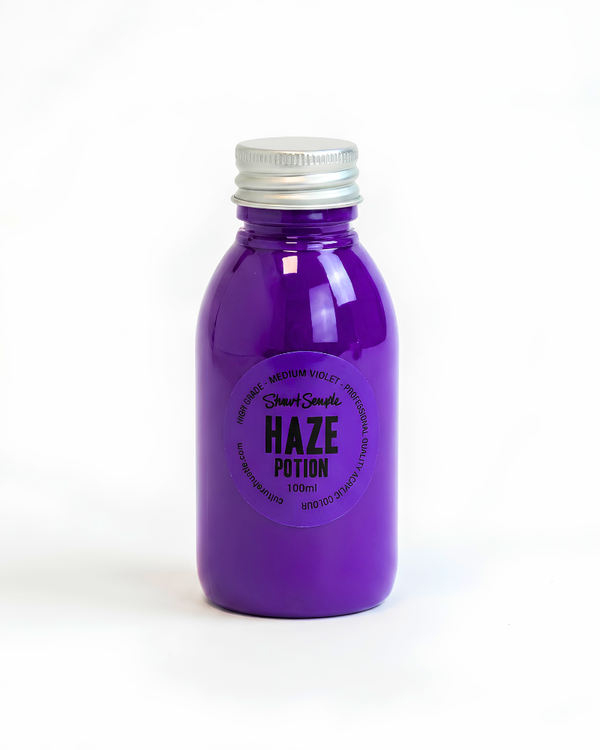
Stuart Semple's best known stand on who gets to use a colour turned the old rules upside down. In February 2016 Anish Kapoor was announced as the only artist allowed to use Vantablack, a super-black coating developed by Surrey NanoSystems.14 On 4 November 2016 Stuart released PINK, a fluorescent pink pigment sold to every artist except Kapoor. Buyers had to declare that they were not Kapoor, were not connected to him and were not buying on his behalf.14 On 23 December Kapoor posted a photo on Instagram of his middle finger dipped in it, captioned "Up yours #pink".14 In 2019 Stuart crowdfunded BLACK 3.0 on Kickstarter under the same exclusion, describing the aim as a "super-affordable, easy-to-use paint that was familiar to artists".15 A sumptuary law once kept purple from everyone but the king. This time the one person left out was the artist who had been given a colour of his own.
- Wikipedia, Tyrian purple, citing K. St Clair, The Secret Lives of Colour (2016) and D. Jacoby, Dumbarton Oaks Papers 58 (2004).
- University of Kansas, Extensive project, new book reveal monument to inflation in Roman times, KU News, 2024.
- Wikipedia, Edict on Maximum Prices.
- Ames Foundation, Harvard Law School, Statute, 37 Edw. III, cc. 8 to 15 (1363).
- Wikipedia, Russet (cloth).
- Wikipedia, Statute Concerning Diet and Apparel 1363.
- Noel Cox, Tudor Sumptuary Laws and Academical Dress: An Act against Wearing of Costly Apparel 1509 and An Act for Reformation of Excess in Apparel 1533, Transactions of the Burgon Society 6, 2006.
- Kitamura Hitomi, niponica 30 feature, Web Japan, Ministry of Foreign Affairs of Japan, 2021.
- Honolulu Museum of Art, Quiet Luxury: Subversive Fashion in the Edo Period, 2026.
- National Gallery, London, Making Colour: Journey through colour.
- SUNY Oneonta, Artist contracts.
- Erin Blakemore, How Malaria Gave Us Mauve, Smithsonian Magazine, 2016.
- Fashion Institute of Technology, Aniline dyes, Fashion History Timeline, 2019.
- Eleanor Gibson, Anish Kapoor flaunts use of "world's pinkest pink" despite personal ban from its creator, Dezeen, 2016.
- Gunseli Yalcinkaya, Black 3.0 is a "black hole in a bottle" that challenges Anish Kapoor's Vantablack pigment, Dezeen, 2019.