Science
Afterimages and the colours that come from nowhere


Stare at a colour long enough and the visual system starts producing its opposite. A look at afterimages, from Goethe at an inn to Chevreul at the Gobelins and the modern argument over whether they start in the eye or the brain.
A colour that isn't there
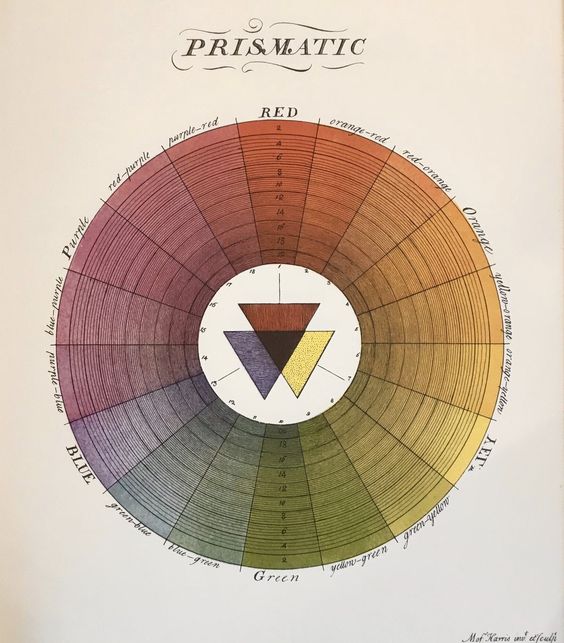
Fix your eyes on a patch of bright orange for half a minute, then look at a white wall. For a few seconds a bluish patch of the same shape floats in front of you. Nothing on the wall is blue. The colour has been produced by your own visual system, and it fades as the system recovers. This is a negative afterimage, and its colour is roughly the complement of whatever you stared at.1

Johann Wolfgang von Goethe gave one of the most vivid descriptions of it in his Theory of Colours, published in 1810. He recalled arriving at an inn towards evening and watching a fair young woman with black hair and a scarlet bodice. When she moved away he saw on the white wall behind her "a black face surrounded with a bright light", and her dress reappeared as a clear sea green.23 Dark hair turned light, pale skin turned dark and red turned green. The afterimage had inverted her.
Two kinds of contrast
The same tendency shows up in two ways. Successive contrast is the afterimage itself, a colour that appears over time after you look away. Simultaneous contrast happens all at once, when colours sitting side by side push each other towards their opposites.4 A grey square on a red ground looks faintly greenish, and the same grey on a green ground looks faintly pink.

Simultaneous contrast got its name and its first systematic study from a dye chemist. Michel Eugène Chevreul became director of dyes at the Gobelins tapestry works in Paris in 1824 and soon received complaints that the colours in the tapestries lacked intensity. He concluded that the fault was optical, not chemical. The threads looked dull because of the colours woven next to them.5 He set out his findings in De la loi du contraste simultané des couleurs, published in Paris in 1839.6 The book became a working manual for textile makers, stained glass workers and designers, and painters including Claude Monet and Georges Seurat put its ideas to use.5
Eye or brain?
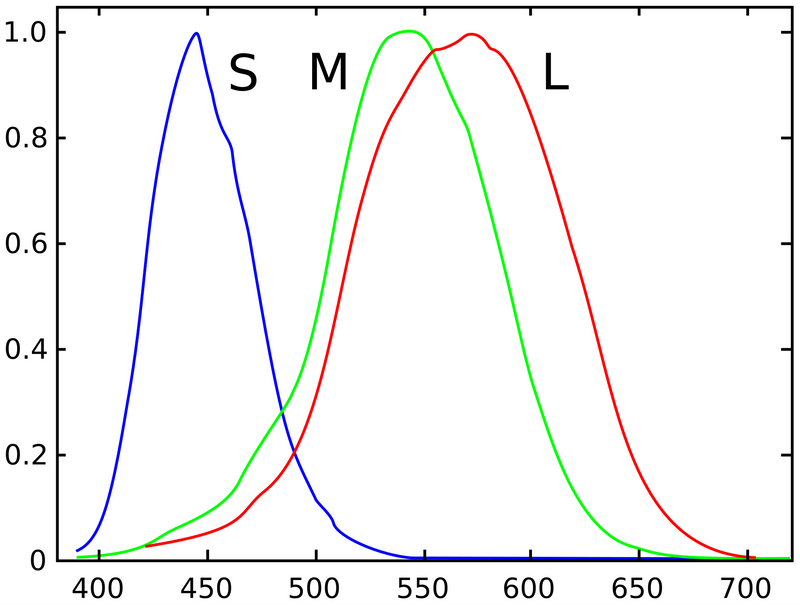
For a long time the standard explanation was simple fatigue. Stare at orange and the cone cells most stimulated by it lose sensitivity, so when you look at white the balance tips the other way.4 Researchers have since argued about where in the visual pathway the effect is actually generated, and the question has not been closed.
In 2001 Shinsuke Shimojo, Yukiyasu Kamitani and Shin'ya Nishida published an illusion in Science that pointed to the brain. Viewers looked at four white discs with coloured wedges cut into them, arranged so that the mind fills in a translucent red square across the middle, although the centre is never actually red. Afterwards many saw a solid green square on a blank screen. Because no red light had ever fallen on that part of the retina, the team argued that the afterimage must come from adaptation in the cortical circuits that fill in the surface.7
A decade later Qasim Zaidi and colleagues recorded directly from retinal ganglion cells in primates, the cells that carry signals from the eye to the brain. All three main classes of these cells adapted to a prolonged colour and produced a rebound response when it stopped, a signal that could serve as an afterimage further along. Their adaptation was much slower than the cones themselves would predict, which suggests the effect is not just tired photoreceptors. Zaidi concluded that "afterimage signals are generated in the retina" but may be modified by the cortex, and argued that the evidence for a cortical origin can be explained in other ways.8 Both findings stand, and the most likely picture is that the retina and the cortex both play a part, with researchers still disagreeing about how much each contributes.
For anyone who paints, dyes or prints, the practical point is the one Chevreul found at the Gobelins. A colour is never seen on its own. What sits next to it and what the eye has just been looking at both change it.
- Wikipedia, Afterimage.
- Johann Wolfgang von Goethe, trans. Charles Lock Eastlake, Goethe's Theory of Colours, paragraph 52, John Murray, 1840 (Project Gutenberg edition).
- Wikipedia, Theory of Colours.
- WebExhibits, Goethe and Chevreul: Simultaneous Contrast, WebExhibits.
- Cooper Hewitt, Smithsonian Design Museum, De la loi du contraste des couleurs, Cooper Hewitt.
- Smithsonian Libraries, Color in a New Light: Using color, Smithsonian Institution.
- California Institute of Technology, New research shows that brain is involved in visual afterimages, Caltech, 2001.
- Qasim Zaidi, Neural locus of color afterimages, Journal of Ophthalmic and Vision Research 7(1), 2012.