Culture
Kerry James Marshall and the black of his figures



Since 1980 Kerry James Marshall has painted Black people in black, mixed from several pigments and handled like any other colour. This is how he does it and why.
A painter who noticed an absence
Kerry James Marshall was born in Birmingham, Alabama, in 1955. In 1963 his family moved to Watts in South Central Los Angeles, a few blocks from the headquarters of the Black Panther Party.1 School trips to the Los Angeles County Museum of Art got him interested in painting, and he went on to study at the Otis Art Institute, where the social realist painter Charles White was a formative influence.2 He has lived and worked in Chicago since the 1980s.2
Walking through the galleries of Western art, Marshall saw the same thing many visitors miss. Black people were mostly not there, and when they were, they tended to be on the edges. His work has been described, by Marshall himself, as "attending to this absence of black representation in the historical narrative".2 His answer was to take on the grandest and most traditional format the museum had to offer, the large figurative history painting, and fill it with Black people going about ordinary lives: getting their hair done, gardening, picnicking, courting.
The 1980 portrait
The turning point was a small egg tempera on paper called A Portrait of the Artist as a Shadow of His Former Self, painted in 1980 when Marshall was 25.3 It shows a man in a black suit and hat against a flat black ground. Almost everything is black. The only things that read clearly are the whites of his eyes, his shirt and a gap-toothed grin.34 Marshall had been reading Ralph Ellison's Invisible Man, and he chose tempera, the medium of early Renaissance panels before oil took over, to put the picture in conversation with that history.4 The white eyes and teeth were deliberate, a reference to the way blackness had been caricatured.4 "Everything changed when I made that painting," he later said.3
The painting has its own odd history. A collector bought it in 1984 for $850, hung it in his home bar, then moved it to his bathroom after guests found it offensive. It stayed there for about 25 years before going on show in Marshall's retrospective and later being given to LACMA.3
How the black is made
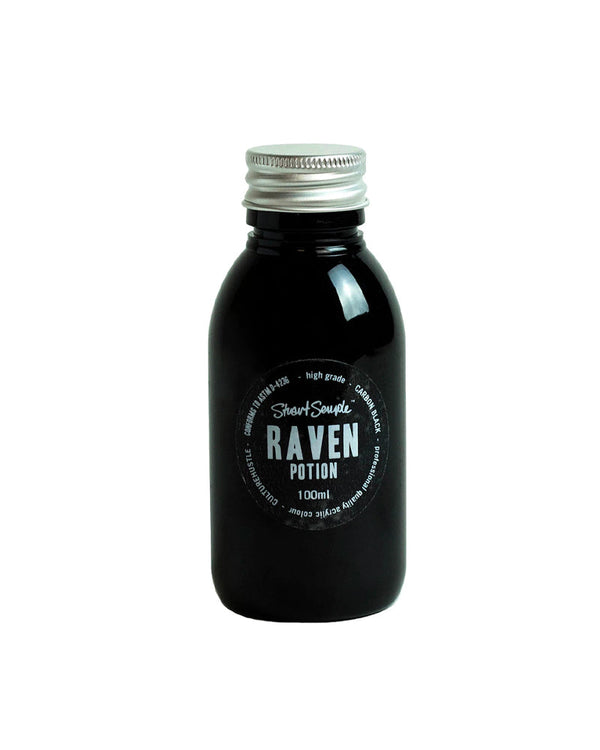
From that point on, Marshall's figures are painted in an unmistakable deep black. It is often assumed to be a single colour straight from the tube. In fact he builds it from several pigments. His starting points are carbon black, ivory black and Mars black, an iron oxide black that runs warm.12 Into these he works cobalt blue, chromium oxide green and earth colours such as raw umber, pushing a face cooler or warmer to give it volume without the usual light and shade modelling.2

In a 2016 film made in his Chicago studio, he lays out seven mixed blacks that he calls "the full range of the black flesh tones". Side by side they look almost identical. Stacked on top of each other, the differences become obvious, and a Mars black laid over pure carbon black turns visibly red.5 His argument is that if black is a colour, it should be treated "chromatically", with the same care as any other colour in the picture.2
He calls the result a "rhetorical blackness", and says the blackness of the figures is "non-negotiable". Nobody looking at them should be in any doubt.12 At the same time he wants them to be "self-possessed", people in their own right and not a sign standing in for something else.2
From the margins to the Met
In 2016 and 2017 the retrospective Kerry James Marshall: Mastry travelled from the Museum of Contemporary Art Chicago to the Met Breuer in New York and then to MOCA in Los Angeles.46 The New York showing had nearly 80 works, 72 of them paintings, covering 35 years. The Met's own press release called his history paintings "defiant assertions of blackness in a medium in which African Americans have long been invisible".6

The market followed. In May 2018 Past Times (1997), his reworking of Seurat's A Sunday on La Grande Jatte with Black figures golfing, waterskiing and playing croquet, sold at Sotheby's in New York for $21.1 million with fees, a record at the time for a living African American artist. The seller was the public authority that runs Chicago's McCormick Place convention centre, which had bought it in 1997 for $25,000.7
British audiences got their own large survey in 2025, when the Royal Academy of Arts in London staged Kerry James Marshall: The Histories, from 20 September 2025 to 18 January 2026.8
Much of the talk about black in recent years has been about surfaces, and how much light a coating can swallow. Marshall's black works the other way. It is a carefully mixed, many-sided colour, and it is there to be looked at.
- Kerry James Marshall and the limitless power of black paint, HuffPost, 2016.
- Kerry James Marshall interview, Apollo.
- LACMA gifted Kerry James Marshall's Portrait of the Artist as a Shadow of His Former Self, Artforum.
- Kerry James Marshall's Mastry, Interview Magazine, 2016.
- Museum of Contemporary Art Chicago, Kerry James Marshall on the colour black (video), MCA Chicago, 2016.
- The Metropolitan Museum of Art, Kerry James Marshall: Mastry (press release), The Met, 2016.
- Victoria L. Valentine, Kerry James Marshall's Past Times soars to record-setting $21.1 million at Sotheby's, Culture Type, 2018.
- Kerry James Marshall: The Histories at the Royal Academy of Arts, Sotheby's, 2025.