History
Egyptian blue, the oldest synthetic pigment


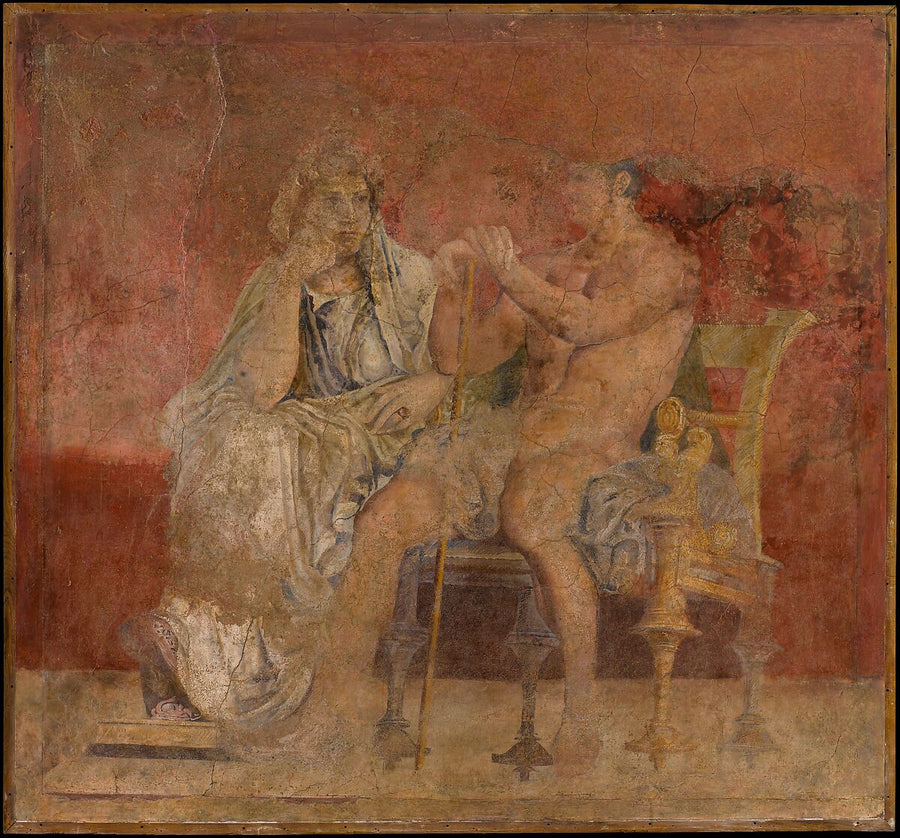

Thousands of years before modern chemistry, Egyptian workshops were firing sand, lime and copper into a blue that does not exist in nature in any useful quantity. It glows in infrared light, which is how scientists are now finding it on the Parthenon marbles.
A blue made in a kiln
For most of history, a painter in the ancient Mediterranean who wanted a strong blue had a supply problem. The finest blue stone, lapis lazuli, reached Egypt from a single valley in north-east Afghanistan, and a shipment could take years to arrive.1 Egyptian craftsmen found another route. They heated quartz sand, lime and a copper mineral such as malachite, with a little alkali (natron or plant ash) to help it fuse, at somewhere between 800 and 1,000°C for several hours.23 What came out of the kiln was a crystalline blue that nobody had dug out of the ground. It is the oldest known synthetic pigment.2

The Egyptians called it ḫsbḏ-jrjt, usually translated as "artificial lapis lazuli".2 How old it is depends on which evidence you count. The earliest trace usually cited is on an alabaster bowl from Hierakonpolis dated to the late Predynastic period, around 3250 BCE.21 Other accounts, including the British Museum conservation scientist Giovanni Verri, date its first regular use to the Fourth Dynasty, around 2500 BCE, the era of the Giza pyramids.45
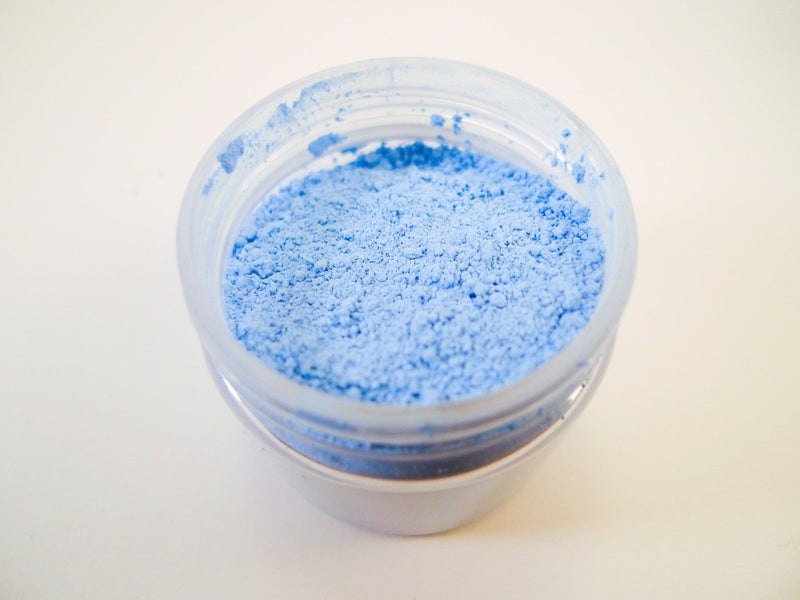
Chemically it is calcium copper silicate, CaCuSi4O10. The same compound does occur in nature, as the rare mineral cuprorivaite, but never in amounts anyone could paint with.2 Modern analysis puts the ingredients at roughly four parts silica to one part lime and one part copper oxide, plus the flux.5
A pigment that shines in infrared
Egyptian blue has an unusual property. When visible light falls on it, it gives off light in the near infrared, which the eye cannot see. Take the infrared-blocking filter out of an ordinary digital camera and photograph a painted surface under the right lighting, and the particles of pigment show up as bright white specks on a grey image.4 Lapis lazuli and azurite do not behave this way, so the method can tell Egyptian blue apart from the other ancient blues without taking a sample.4 Verri published a version of the technique in 2009.2 In 2018 researchers at Lawrence Berkeley National Laboratory found the glow was about ten times stronger than previously estimated, with the pigment re-emitting nearly as many photons as it absorbs.6
The results have been striking on sculpture that most people think of as plain stone. A team led by Verri, now at the Art Institute of Chicago, used the method on the Parthenon marbles in the British Museum. They found Egyptian blue in the scene of Helios rising with his chariot, where it seems to stand for water, and in elaborate designs on the mantle of a figure thought to be the goddess Dione.7 Traces that are invisible to the naked eye show that these carvings were once painted.
Across the ancient world
The pigment travelled well beyond Egypt. The Greek writer Theophrastus called it kyanos, the Etruscans used it in wall paintings, and the Romans knew it as caeruleum.2 In the first century BCE the architect Vitruvius described how it was made and credited a man called Vestorius with bringing the technique from Alexandria to Pozzuoli on the Bay of Naples.23

China had a close relative of its own. Han blue has the same basic crystal structure but contains barium where Egyptian blue has calcium, and it was made at temperatures 100 to 200°C higher. It was in use from the Western Zhou period until the end of the Han dynasty around 220 CE. Some scholars think the knowledge came along the Silk Road from the West. Others argue it was invented independently, pointing out that Egyptian blue itself has rarely been found in China. The question is still open.8
Lost and found
After the Roman period the pigment faded from use, though sources disagree on how quickly. One account has it dying out in the fourth century CE, yet it turns up in a fifth or sixth century mural fragment from the church of St Peter above Gratsch in South Tyrol, and traces of it continue into the early Middle Ages.2 The Royal Society of Chemistry puts its disappearance from common use after about 660 CE.5 No Egyptian recipe for it survives.3
Its modern rediscovery came from Humphry Davy, the chemist better known for the miners' safety lamp. While in Rome he found several large lumps of deep blue frit among rubbish at the Baths of Titus, and then the same material on a pot at Pompeii.3 His analysis showed sand, lime and a copper compound, although he could not pin down which copper compound it was.5 He wrote up the work in Rome and it was read to the Royal Society on 23 February 1815 as "Some experiments and observations on the colours used in painting by the ancients".9
The same infrared glow that helps conservators find the pigment has given it a second life in the laboratory. The Berkeley team proposed using it in coatings that keep roofs and walls cooler in strong sun, and in tinted windows that pass the re-emitted infrared to solar cells along their edges.6 A colour first fired in an Egyptian kiln is now being tested as building material.
- Tom Verde, The quest for blue, AramcoWorld, 2021.
- Wikipedia, Egyptian blue.
- Paul Brack, Egyptian blue: more than just a colour, Chemistry World.
- Harvard Art Museums, Exciting pigments, Harvard Art Museums.
- Royal Society of Chemistry, Egyptian blue, RSC Education.
- Lawrence Berkeley National Laboratory, Ancient pigment can boost energy efficiency, Berkeley Lab News Center, 2018.
- Daniel Weiss, The Parthenon's paint job, Archaeology, 2024.
- Wikipedia, Han purple and Han blue.
- The Royal Society, Paper, 'Some experiments and observations on the colours used in painting by the ancients' by Sir H Davy, Science in the Making, 1815.