History
Scheele's green and the arsenic in the Victorian home


In 1775 a Swedish chemist made a brilliant green out of copper and arsenic, and for nearly a century it went onto walls, dresses, books and sweets. This is the story of who it harmed, what it did or did not do to Napoleon, and why colour has never been a neutral thing.
A green from a chemistry lab
In 1775 the Swedish chemist Carl Wilhelm Scheele produced a vivid green from copper and arsenic. He published the recipe in 1778, and the pigment, a copper arsenite, has carried his name ever since.1 Scheele reportedly warned a friend that the colour was poisonous before it went into production. It was made anyway.2

Painters and manufacturers had good reason to want it. The older greens each had a problem. Verdigris, the green rust of copper, was prone to discolour, malachite had to be ground from a mineral, and the green earths were muted. Scheele's green was bright and cheap to make, though it tended to blacken in air that carried sulphur. In 1814 the firm of Wilhelm Sattler in Schweinfurt, Germany, began selling an improved version known as emerald green or Schweinfurt green, a copper aceto-arsenite that was brighter and more durable but just as toxic. The colourman George Field found that it blackened in sulphurous air much as Scheele's green did.34 The same pigment was later also sold as Paris green.56 Between them, these two arsenical greens coloured much of the nineteenth century.
Walls, flowers and dresses
The pigments went into wallpaper, textiles, paints, candles, bookbindings, children's toys and even food colouring for sweets.1 Food was the most direct route into the body. In June 1848 caterers at a celebration in the Temperance Hall in Northampton decorated a blancmange with leaves dyed with Schweinfurt green, using more than usual to get a better colour. One guest ate about half a pound of it and was dead by five the next morning. Two caterers were convicted of manslaughter that summer.7

Wallpaper was the biggest outlet. British production rose by about 2,600 per cent between 1834 and 1874, as printing was mechanised and the tax on wallpaper was cut and then abolished.8 When the National Archives in London tested the 275 Victorian wallpapers reproduced in Lucinda Hawksley's book on the subject, every one of them contained arsenic.4 William Morris used arsenical greens in his early designs, and his family's fortune came partly from shares in Devon Great Consols, the mine his father had helped set up. It became one of the largest arsenic producers in the world and from 1867 was the main supplier of arsenic for green pigments. Morris was a director from 1871 to 1875.98 He moved his own production away from arsenic in the 1870s, but as late as 1885 he wrote to the dyer Thomas Wardle that the doctors "were bitten as people were bitten by the witch fever".826
The worst harm fell on the people who made these things. Artificial flower makers dusted fabric leaves with green powder and breathed it all day. In November 1861 Matilda Scheurer, a 19-year-old flower maker in London, died after convulsing and vomiting. Her fingernails and the whites of her eyes had turned green, she told her doctor that everything she looked at was green, and the post-mortem found arsenic in her stomach, liver and lungs. Her death helped turn public opinion. The following year the Punch cartoonist John Leech drew The Arsenic Waltz, in which two skeletons in evening dress dance together.1026 The trade went on regardless. Medical writers in 1879 described one factory employing a hundred girls where twenty-six showed symptoms of chronic poisoning, one had died after months of ulceration, and only four seemed to be free of symptoms.11 The historian Alison Matthews David, author of Fashion Victims, points out that women who wore green dresses and flower wreaths mostly suffered rashes, while the workers who made them were the ones who died.102 The doctor Jabez Hogg recorded one such case in 1879, a woman with a troublesome skin eruption caused by the artificial flowers in her bonnet.11
Homes were not safe either. In 1862 a family named Turner in Limehouse, east London, lost their fourth child, aged three. The children had been peeling and licking strips of green wallpaper, and a toxicologist was finally called in. The inquest jury still returned a verdict of death from natural causes.8 Other cases turned up in the medical literature. A child in Peckham died after sucking a piece of arsenical wallpaper, the surgeon Robert Brudenell Carter believed two of his own children had died from the paper in their nursery, and in Birmingham a couple and their parrot all became ill within a week of new wallpaper going up.11
The alarm reached the United States too. In 1874 the Michigan State Board of Health published Shadows from the Walls of Death, prepared by the physician Robert Clark Kedzie, a book bound from real samples of arsenical wallpaper and meant as a warning. About a hundred copies were printed. Many recipients destroyed theirs out of fear, and only around half a dozen survive.12
Britain never passed a law banning arsenic in wallpaper. The industry moved to arsenic-free colours as the evidence mounted and buyers started asking for papers sold as "arsenic free".84 By around 1900 Scheele's green had dropped out of use as a pigment.1
What about Napoleon?
Napoleon spent his last years on Saint Helena at Longwood House, which was notoriously damp. The theory that he was poisoned with arsenic goes back to a paper in Nature in October 1961, which reported a significant level of arsenic in a sample of his hair taken the day after he died, analysed at the Department of Forensic Medicine in Glasgow.13 In 1980 the chemist David Jones asked BBC radio listeners whether anyone knew the colour of Napoleon's wallpaper. A listener in Norfolk, Shirley Bradley, had a fragment that an admirer had torn from the wall and pasted into a family scrapbook. Kenneth Ledingham at Glasgow University analysed it by X-ray fluorescence and found arsenic in it, and the two men published the result in Nature in 1982. Jones linked it to the Italian physician Bartolomeo Gosio's finding that mould on damp wallpaper could release an arsenic gas.14 Gosio had shown in 1892 that certain moulds could turn arsenic pigments into a gas that smelled of garlic.15

Jones himself did not claim the wallpaper killed Napoleon. He thought Napoleon was already dying of a stomach complaint and that the arsenic might have hastened his death by a day or so at most.14 Later research has made the wallpaper look even less important. In 1932 Frederick Challenger and his colleagues identified Gosio's gas as trimethylarsine. In 2005 the chemists William Cullen and Ronald Bentley reviewed the evidence and concluded that trimethylarsine has very low toxicity whether breathed or swallowed, that moulds produce only very small amounts of it, and that it could not have caused the illnesses blamed on it. They called the poison gas story an urban myth.15 In 2008 Italian physicists, among them Ettore Fiorini of Milano-Bicocca University, measured arsenic in hair taken from Napoleon as a child, on Elba and on Saint Helena, alongside hair from his son and from Josephine. All of it held roughly 100 times the arsenic found in hair today, and Napoleon's levels were similar to those of his contemporaries. The team concluded he had been exposed throughout his life, as most people of his time were, and that his death was probably natural. The official cause was stomach cancer.16 So the green wallpaper is real, and the arsenic in his hair is real, but the idea that his decor killed him does not hold up.
Still on the shelves
The greens have not entirely gone away. The Poison Book Project at Winterthur Museum in Delaware has identified more than 150 nineteenth-century books coloured with emerald green, most of them from the 1850s. One cover tested at an average of 1.42 milligrams of arsenic per square centimetre. Staff handle them in nitrile gloves, and some have been sealed in polyethylene bags and taken out of circulation.17
Colour has always cost something
Scheele's green is an extreme case of something that runs right through the history of colour. Ultramarine was ground from lapis lazuli mined in Afghanistan, and the best grades could be worth more than gold, so patrons sometimes specified in contracts how much of it a painter should use.18 Tyrian purple came from sea snails. Pliny the Elder wrote that thousands were needed for a single ounce of dye, and Julius Caesar made the colour his own, a habit later emperors kept up.19 Who could get hold of a colour, and at what price, has often decided who got to use it.
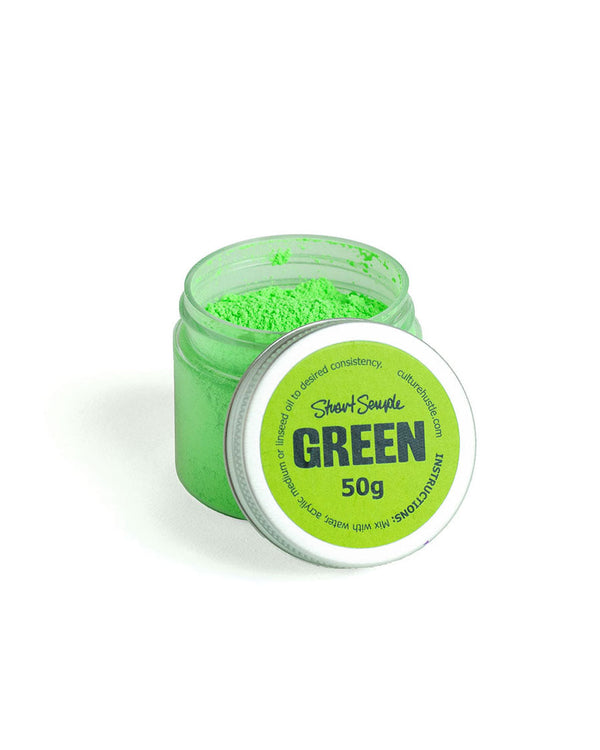
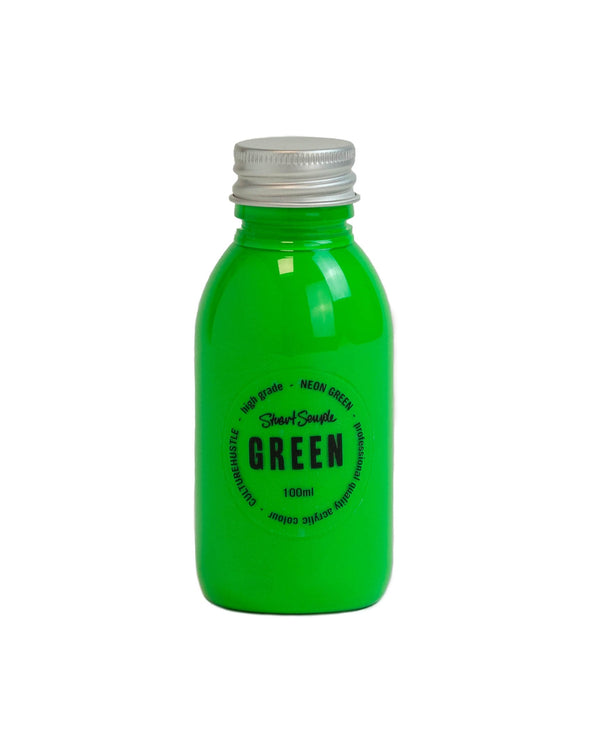
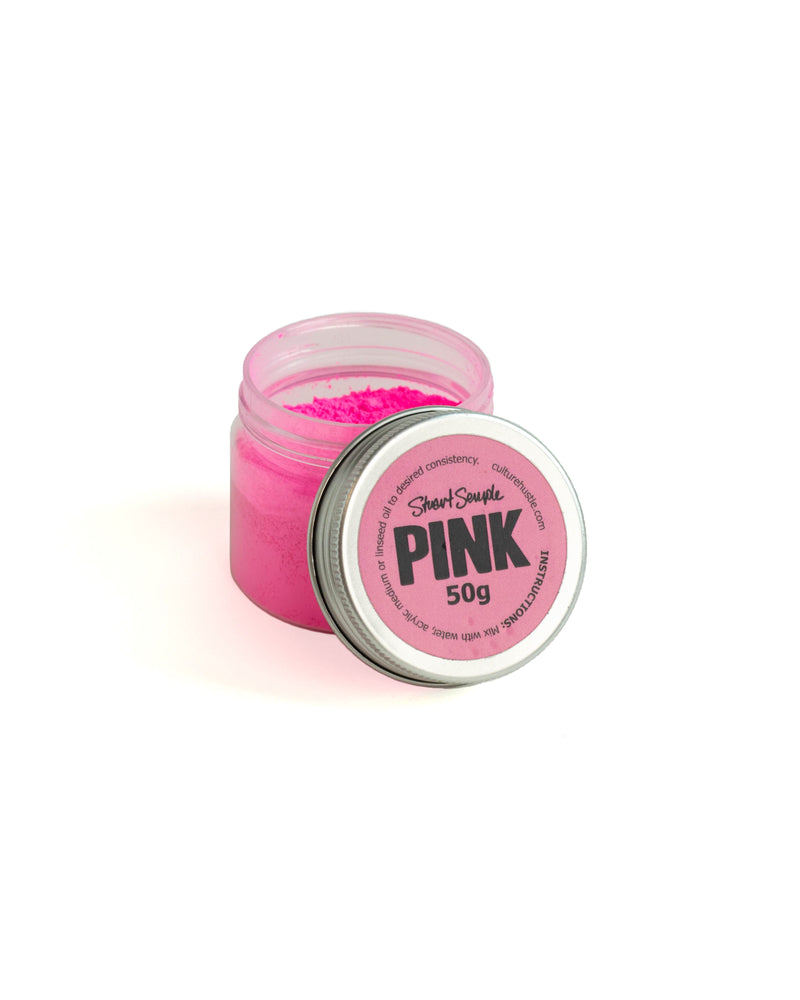
That question came back in 2016, when Anish Kapoor was given exclusive artistic rights to Vantablack, an ultra-black coating made by Surrey NanoSystems. Other artists, including Christian Furr, objected to one person controlling a material.20 Stuart Semple's answer, released in November 2016, was PINK, sold for £3.99 a pot to anyone who would declare at checkout that they were not Anish Kapoor and not buying on his behalf. On 23 December 2016 Kapoor posted a photograph on Instagram of his middle finger dipped in it, captioned "Up yours #pink".21 The paints were safe. The argument, about who gets access to a colour, was one the nineteenth century would have recognised.
- Wikipedia, Scheele's green.
- Katy Kelleher, Scheele's Green, the Color of Fake Foliage and Death, The Paris Review, 2018.
- WebExhibits, History of Emerald green, Pigments through the Ages.
- Allison Meier, Death by Wallpaper: The Alluring Arsenic Colors that Poisoned the Victorian Age, Hyperallergic, 2016.
- Wikipedia, Paris green.
- Kat Eschner, Arsenic and Old Tastes Made Victorian Wallpaper Deadly, Smithsonian Magazine, 2017.
- Sithara Ranasinghe, Adulterations Detected: On the human impulse to prettify our food with poison, Design Observer, 2025.
- Jacqueline Banerjee, Review of Lucinda Hawksley, Bitten by Witch Fever: Wallpaper and Arsenic in the Victorian Home, The Victorian Web.
- Andrew Meharg, The arsenic green, Nature 423, 688, 2003.
- National Geographic, Killer Clothing Was All the Rage in the 19th Century, National Geographic, 2016.
- Susan Isaac, Arsenic: a domestic poison, Royal College of Surgeons of England Library blog, 2018.
- The Public Domain Review, Shadows from the Walls of Death (1874).
- Barbara Krajewska, Arsenic and the Emperor, Fondation Napoléon, 2004.
- David Jones, Napoleon's wallpaper, Chemistry World.
- William R. Cullen and Ronald Bentley, The toxicity of trimethylarsine: an urban myth, Journal of Environmental Monitoring, Royal Society of Chemistry, 2005.
- Physics World, Napoleon not murdered, say physicists, Physics World, 2008.
- National Geographic, These green books are literally poisonous, National Geographic, 2022.
- The National Gallery, Colour stories: Blue, The National Gallery, London.
- Smithsonian Magazine, In Ancient Rome, Purple Dye Was Made from Snails, Smithsonian Magazine.
- Artforum, Artists Angered as Anish Kapoor Receives Exclusive Rights to Vantablack, Artforum, 2016.
- Dezeen, Anish Kapoor flaunts use of "world's pinkest pink" despite personal ban from its creator, Dezeen, 2016.