History
Cennino Cennini's recipe for the perfect blue


Around 1400 a Florentine painter wrote down how to pull ultramarine out of lapis lazuli. His recipe, with its wax, lye and three days of kneading, explains why the blue was so precious and why patrons kept such a close eye on it.
A painter's handbook
Cennino d'Andrea Cennini was born around 1370 in Colle di Val d'Elsa in Tuscany and trained in Florence under Agnolo Gaddi. Agnolo had learned from his father Taddeo, who had worked with Giotto, and Cennini was proud of that line of descent.12 No painting can be securely attributed to him today. What survives is his book, Il Libro dell'Arte, probably written in the late 1390s, a practical manual for apprentices covering everything from preparing panels to laying gold.1 It sat in manuscript for more than four centuries before it was first printed in Rome in 1821.2

Its chapter on ultramarine opens with the line that every history of blue seems to quote. In Daniel V. Thompson's translation, ultramarine is "a color illustrious, beautiful, and most perfect, beyond all other colors".3 Less often quoted is what comes next, which is a recipe, and a long one.
Kneading the blue out of the stone
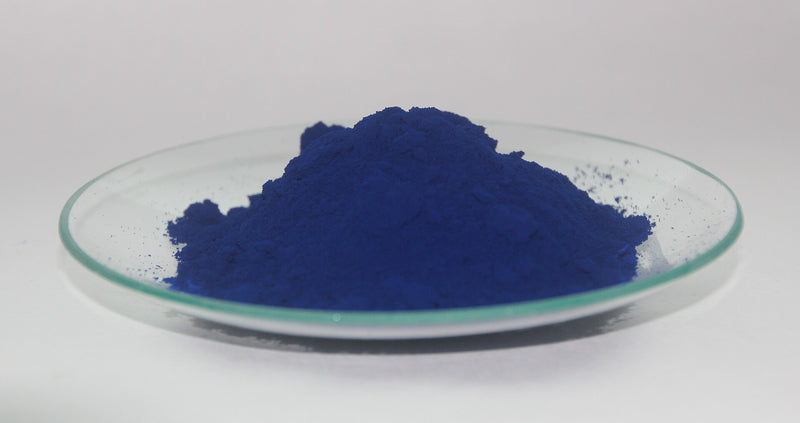
Grinding lapis lazuli alone gives a dull greyish blue, because the blue mineral, lazurite, is mixed in with other, colourless minerals.4 Cennini tells the painter to pick the lapis richest in blue and to be careful not to confuse it with azurite, a cheaper blue stone. The lapis is pounded in a covered bronze mortar, ground dry on a porphyry slab and sifted.3
Then comes the clever part. For each pound of powdered stone, he calls for six ounces of pine rosin, three ounces of gum mastic and three ounces of new wax, melted together and mixed with the lapis into a sticky lump. The painter keeps his hands greased with linseed oil while handling it, and the lump has to rest for at least three days and three nights, worked over a little each day.3 After that it is kneaded in warm lye, "just as you work over bread dough with your hand". The blue particles let go of the waxy mass and sink into the lye, while most of the grey rock stays trapped in the dough.34
The lye is poured off into a bowl, fresh lye is added and the kneading starts again. Each round gives a weaker blue than the one before. Cennini leaves the number of rounds to the painter, "whether three or four, or six, or however many you want", and warns against spoiling the first blues by mixing in the poor ones.3 The first extractions were the deep, intense blue. The last gave a pale greyish powder known as ultramarine ash, and painters used every grade.4 Conservators believe this wax method was in use by about 1200.4
Cennini also has views on who should do the work. Making ultramarine, he writes, "is an occupation for pretty girls rather than for men", and he adds the warning "Just beware of old women."3 He gives no further explanation.
Eight ducats an ounce
He is equally direct about money. With good lapis, he says, the blue from the first two yields "will be worth eight ducats an ounce".3 Records from Florence in the mid 15th century put good ultramarine at ten to fifteen times the price of azurite, with even the lower grades costing around two thirds as much as the best.4 The stone came from Badakhshan in what is now Afghanistan and reached Italian painters through the Middle East and Venice, so every merchant along the way added to the price.4

Who held the blue
A material that valuable was not always left in the painter's hands. In early Renaissance contracts patrons often supplied the ultramarine themselves, as they did gold leaf, or paid for it as a separate item, and the amount used could feed into the value of the finished painting.4

The habit lasted well into the 16th century. In the summer of 1545 Agnolo Bronzino wrote to the majordomo of Cosimo I de' Medici asking for more blue pigment for a picture with a large deep blue background. Conservators have linked that letter to his portrait of Eleonora of Toledo in the Uffizi. The letter does not name the pigment, but accounts of blue changing hands at this date usually concern ultramarine, because of the considerable expense of lapis lazuli.5
Painters also learned to leave the blue until last. Michelangelo's Entombment in the National Gallery, London, painted in Rome around 1500 to 1501, was abandoned when he went back to Florence to take on the block of marble that became his David. On the right is an empty space probably meant for the kneeling Virgin Mary. Her mantle would have needed ultramarine, and the National Gallery suggests he may have held off adding the colour until the very end.6 More than five centuries later the gap is still there, an unpainted space where the most expensive colour in the picture was supposed to go.
- The National Gallery, Cennino Cennini, glossary, The National Gallery, London.
- Wikipedia, Cennino Cennini, Wikipedia.
- Cennino Cennini, trans. Daniel V. Thompson Jr., The Craftsman's Handbook (Il Libro dell'Arte), chapter LXII, On the character of ultramarine blue, and how to make it, Yale University Press, 1933.
- Cathleen Hoeniger, The identification of blue pigments in early Sienese paintings by color infrared photography, Journal of the American Institute for Conservation 30 (2), 1991.
- Serena Urry, Evidence of replication in a portrait of Eleonora of Toledo by Agnolo Bronzino and workshop, Journal of the American Institute for Conservation 37 (2), 1998.
- The National Gallery, Michelangelo, The Entombment (or Christ being carried to his Tomb), about 1500-1, The National Gallery, London.