History
How ultramarine went from luxury to everyday blue



For centuries the finest blue in European painting came from a single region of Afghanistan and cost more than gold. Then, in the 1820s, French chemists worked out how to make it in a factory.
A stone from Badakhshan
High in the mountains of Badakhshan, in northeastern Afghanistan, the mines at Sar-i Sang have produced lapis lazuli for more than 6,000 years.1 The stone travelled astonishing distances long before anyone thought of turning it into paint. Lapis inlays sit in the gold funeral mask of Tutankhamun, made in the 14th century BCE, which means the blue on that mask had already crossed thousands of kilometres of desert, river and sea, through the hands of traders, before an Egyptian craftsman set it in place.1
Turning lapis into a usable pigment was harder than grinding it up. Crushed lapis on its own gives a disappointing greyish blue, because the blue mineral is mixed with other rock.2 The earliest known paintings using lapis-based ultramarine are 6th-century wall paintings in Afghanistan.32 By the time it reached Europe, the pigment had acquired its name: ultramarine, from the Latin and Italian for "beyond the sea", because that is where it came from.2
Paid for by the ounce
In Renaissance Europe good ultramarine was more expensive than gold.3 That price shaped what it was used for. It was the blue of choice for the most important parts of a picture, and above all for the robes of Christ and the Virgin Mary in Italian panel paintings and illuminated manuscripts of the 14th and 15th centuries.3 Cheaper blues such as azurite did the rest.2

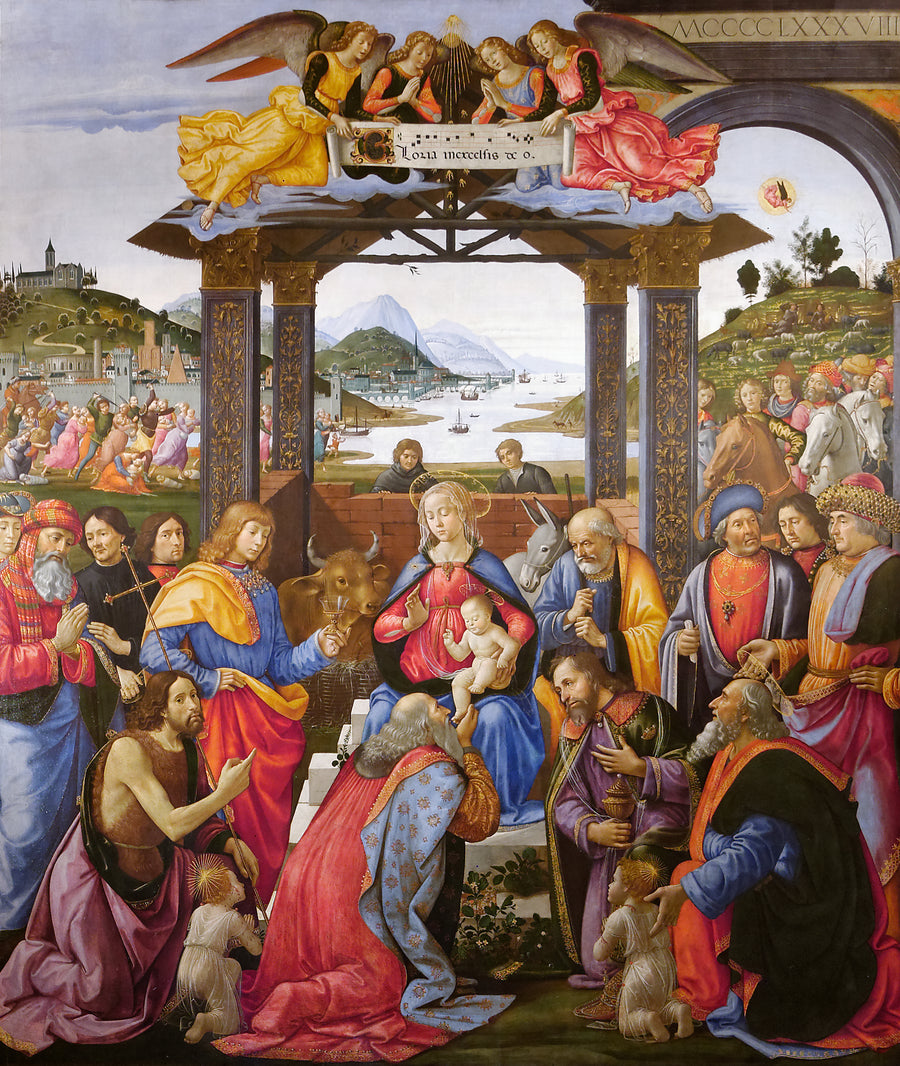
Patrons knew exactly what they were paying for, and some wrote it into the contract. When the prior of the Ospedale degli Innocenti in Florence commissioned an Adoration of the Magi from Domenico Ghirlandaio in 1485, the agreement specified that the blue must be ultramarine "of the value of four florins the ounce".45 The art historian Michael Baxandall used contracts like this one to show how Florentine buyers thought about paintings in terms of materials and money as well as skill.4 A blue robe was a visible receipt.
Vermeer's blue
Two centuries later Johannes Vermeer, working in Delft, used natural ultramarine more freely than almost any painter of his time. Technical studies by the National Gallery in London describe him using it liberally and in ways that were almost unorthodox.6 He mixed it with red lake to make purples, with green earth for blue greens, and put it into the shadows of flesh and the grey of plain walls, places where most artists would never have spent it.6 The same studies found silica in one blue sample, which suggests the ultramarine had been bulked out with something cheaper, either by a dealer or by Vermeer himself.6

Vermeer died in Delft in December 1675, aged 43, leaving his widow Catharina Bolnes with eleven children, most of them still minors, and serious debts.7 It is often said that ultramarine ruined him, but that is not what the record says. In her petition to the High Court of Holland, Catharina blamed the long and ruinous war that followed the French invasion of 1672. During it, she said, he had been unable to sell his own paintings, and was left holding works by other masters he dealt in, at a great loss.7 She owed the baker Hendrick van Buyten more than 617 guilders for bread and gave him two of her husband's paintings as security, with permission to repay the debt slowly over the following years.8 His materials were expensive, but war and a collapsed art market were what sank the family.
The prize for a cheaper blue
By the early 19th century chemists had noticed that a blue substance formed on the walls of lime kilns and soda furnaces looked a great deal like lapis.3 In 1824 the Société d'Encouragement pour l'Industrie Nationale in Paris offered a prize of 6,000 francs to anyone who could make synthetic ultramarine for no more than 300 francs a kilo.3
Jean-Baptiste Guimet, a French chemist, found a process in 1826 and kept it secret. He was awarded the prize in February 1828.39 Christian Gmelin, a chemistry professor at Tübingen, published his own method shortly afterwards and claimed he had got there first, but the French society stuck with Guimet.3 Synthetic ultramarine has the same basic crystal structure as the blue mineral in lapis and is made by heating common materials such as clay, soda, sulphur and carbon together.29
Guimet's blue sold for about 400 francs a pound when natural ultramarine cost somewhere between 3,000 and 5,000 francs a pound in Paris.3 Production went industrial and the price kept falling.2 Within a few decades a colour that had once been written into contracts by the ounce was cheap enough for any painter to squeeze from a tube.
A sky full of it
Later 19th-century painters used the new blue without a second thought. Pigment analysis of Vincent van Gogh's The Starry Night, painted in 1889, found that the deep blue sky surrounding the stars is mostly artificial ultramarine, with cobalt blue in the brighter swirls and around the moon.10 For Van Gogh it was simply one of the blues on his palette, which is exactly what makes it remarkable. Three centuries earlier, a sky that size in the real thing would have been out of reach for almost anyone.

That shift is the reason the story matters to Stuart Semple. His long-running argument, from PINK onwards, is that extraordinary colours should not be reserved for whoever can afford to lock them up. Ultramarine is the oldest example of a colour making that journey, from four florins an ounce to something anyone could buy, and it happened because chemists set out to make it cheap.
- Wikipedia, Lapis lazuli.
- Wikipedia, Ultramarine.
- WebExhibits, History of ultramarine, Pigments Through the Ages.
- Michael Baxandall, Les commanditaires dans la Florence de la Renaissance (extract from L'Oeil du Quattrocento, Gallimard, 1985, p. 39), Académie de Strasbourg.
- Wikipedia, Adoration of the Magi (Ospedale degli Innocenti).
- National Gallery, Vermeer's palette, The Meaning of Making.
- The Frick Collection, Frick's Vermeers.
- Essential Vermeer, Vermeer's life.
- Wikipedia, Jean-Baptiste Guimet.
- ColourLex, Vincent van Gogh, The Starry Night.