History
Why red was sacred



From ochre ground in a South African cave 100,000 years ago to Rothko's dark red murals, a short history of how red came to carry life, death, money and power.
The oldest colour workshop
In 2008 archaeologists working at Blombos Cave, on the southern Cape coast of South Africa, found two abalone shells that had been used as containers for a red paste. Dated to about 100,000 years ago, the shells sat among a small toolkit of grindstones, hammerstones, bone and charcoal. The team, led by Christopher Henshilwood, published the find in Science in 2011 and described it as an ochre processing workshop.1 The recipe was more involved than crushed rock and water. The residues suggest ochre was ground and mixed with heated, crushed mammal bone, charcoal, stone chips and a liquid.2
Ochre is earth coloured by iron oxide, and it is the first pigment we can show people deliberately prepared. Nobody knows exactly what the Blombos paste was for. The researchers suggest decoration, painting or protecting the skin, and those are possibilities rather than conclusions.2 What the find does show is that somebody went to the trouble of making red on purpose, with a method and a set of tools, long before writing or farming.
Red for the dead
Red turns up again and again in graves. In 1823 the Oxford geologist William Buckland dug a partial skeleton out of Goat's Hole Cave at Paviland on the Gower peninsula in Wales. The bones were stained with red ochre. Buckland decided they belonged to a woman, probably from the Roman period, and the burial has been called the Red Lady of Paviland ever since. He was wrong on both counts. The remains are those of a young man, and radiocarbon dating published in 2008 put him at around 33,000 to 34,000 years old.3
On the other side of the Atlantic, and tens of thousands of years later, the Maya used a different red mineral for the same kind of job. In 1994 a team led by Arnoldo González Cruz opened a sealed seventh century tomb inside Temple XIII at Palenque in Mexico. The woman buried there, her jade mask and her grave goods were all coated in bright red cinnabar, which is mercury sulphide and is toxic. She is known as the Red Queen. Her identity has not been settled, though one proposal is that she was Ix Tz'akb'u Ajaw, wife of the king Pakal.4 Why the Maya covered their dead in cinnabar is also unclear. Links to resurrection and to the colour of the rising sun have been suggested.4
Vermilion and the painters' red
Cinnabar ground into pigment is vermilion, and by the late Middle Ages European painters were mostly using a synthetic version made from mercury and sulphur. Cennino Cennini, writing his painters' handbook in Florence around 1400, said vermilion was "made by alchemy, prepared in a retort" and did not bother to explain the process, since you could buy it from the druggist. His practical advice was to buy it as an unbroken lump, never ready ground, because the powdered stuff was usually cut with red lead or pounded brick.5 A pigment worth faking was a pigment worth money.
An insect from the Americas
The other great red of European painting came from an insect. Cochineal, Dactylopius coccus, is a scale insect that feeds on Opuntia cactus and is native to Mexico and parts of South America. Its body and eggs contain carminic acid, the source of carmine. After the conquest of Mexico, Spain controlled the trade for around three centuries. It banned the export of live insects and let the rest of Europe believe that cochineal was a seed or a grain. Cochineal became the second most profitable export from the Americas after silver. The monopoly only broke after a French naturalist smuggled live insects out of Oaxaca in 1777.6

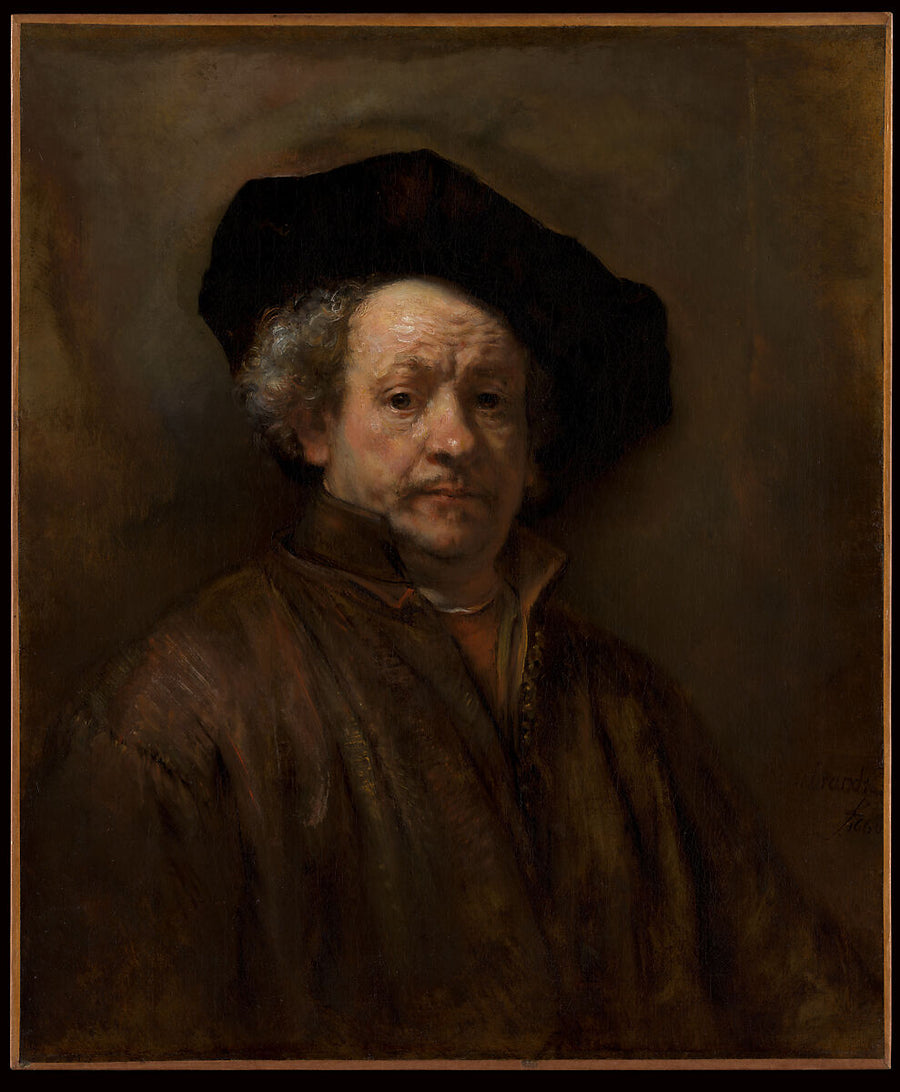
Painters used it in red lakes, translucent pigments made by fixing a dye onto a mineral base. In a study of red lakes in paintings at the National Gallery in London, Jo Kirby and Raymond White found that scale insect dyes already appear in Italian paintings of the fifteenth and early sixteenth centuries, and that cochineal predominated in the seventeenth century.7 Rembrandt's Self Portrait at the Age of 63 is one example. Analysis by National Gallery scientists found he used two red lakes in it, one of them cochineal carmine.8 Carmine is still made from the same insect and still goes into food.6
Red and power
Some of the colours of power that get called red were really purple. The dye the Romans prized most came from the glands of Mediterranean sea snails. Pliny the Elder wrote that thousands of snails were needed for a single ounce, and Julius Caesar adopted the colour as his own, with later emperors following.9

The red of Catholic cardinals is more direct about what it means. The scarlet is explained by the Church as a symbol of blood and of a cardinal's willingness to die for the faith.10 It is a neat example of red standing for life and death at once.
Not every famous red carries that much meaning. When Giles Gilbert Scott won the 1924 competition to design the K2 telephone kiosk, introduced in 1926, he wanted it silver on the outside. The General Post Office painted it in its own trademark red instead, which made the boxes easy to spot in the street.11
Rothko's dark reds
In 1958 Mark Rothko accepted a commission to paint murals for the Four Seasons restaurant in the Seagram Building in New York. As he worked, his palette moved towards dark reds, browns and blacks.12 According to an account published in Harper's in July 1970, he said he hoped to paint something that would "ruin the appetite of every son of a bitch who ever eats in that room".1314 In the end he decided a restaurant was the wrong place for the work. He pulled out of the commission and returned his fee.15
In 1968 and 1969 he gave nine of the paintings to the Tate. He admired Turner and hoped they would hang near the Turner Bequest.1216 They reached London in 1970, the year Rothko died.12 Tate has since shown them as a group at Tate Britain, Tate Modern, Tate Liverpool and Tate St Ives.15 Rothko said he was interested only in "expressing basic human emotions", and listed tragedy, ecstasy and doom among them.12 Standing in a dim room with those maroon canvases, it is hard not to think of the ochre in the grave at Paviland.
- Christopher S. Henshilwood et al., A 100,000-year-old ochre-processing workshop at Blombos Cave, South Africa, Science, 2011.
- ScienceDaily, 100,000-year-old ochre toolkit and workshop discovered in South Africa, ScienceDaily, 2011.
- Oxford University Museum of Natural History, The 'Red Lady' of Paviland, University of Oxford.
- National Geographic, Maya Red Queen, National Geographic History, 2017.
- Cennino Cennini, trans. Daniel V. Thompson, The Craftsman's Handbook (Il Libro dell'Arte), chapter XL, noteaccess.com.
- Department of Geography, University of California Santa Barbara, Cochineal: a little insect goes a long way, UCSB.
- Jo Kirby and Raymond White, The identification of red lake pigment dyestuffs and a discussion of their use, National Gallery Technical Bulletin vol. 17, 1996.
- ColourLex, Rembrandt, Self-Portrait at the Age of 63, ColourLex.
- Smithsonian Magazine, In this ancient workshop, Greeks crushed snail glands to make the purple dye worn by royalty, Smithsonian, 2024.
- TheJournal.ie, Why do cardinals wear red?, TheJournal.ie, 2013.
- London Museum, London's iconic red telephone boxes, London Museum.
- Tate, Mark Rothko: Seagram murals, Tate Britain, 2022.
- John Fischer, Portrait of the artist as an angry man, Harper's Magazine, 1970.
- Art Nerd New York, Rothko and the Four Seasons, Art Nerd.
- Tate, Rothko's Seagram murals at Tate St Ives, Tate press release, 2024.
- Tate, After more than 20 years Rothko's Seagram murals return to Tate Liverpool, Tate press release, 2009.