Science
Why the sky is blue and sunsets are red


A sunset is daylight with most of the blue taken out. The physics behind it runs from Tyndall's smoke-filled tube to the volcanic skies painted by Turner and, possibly, Munch.
White light and very small things
Sunlight looks white because it carries the whole visible spectrum at once, from long red wavelengths to short blue and violet ones. On its way down through the atmosphere it meets molecules of nitrogen and oxygen, which are far smaller than the wavelength of visible light. These molecules scatter some of the light off in new directions, and they scatter short wavelengths much more readily than long ones.1

The first person to show this happening in a laboratory was John Tyndall. In 1869, in the basement of the Royal Institution in London, he shone white light down a glass tube and slowly filled it with smoke. Seen from the side, the beam looked blue. Seen from the far end, it looked red.2 Tyndall thought the blue of the sky came from fine particles of dust or vapour. Lord Rayleigh put numbers to the effect in papers published in 1871, and in 1899 he applied the same reasoning to the air molecules themselves, which is the explanation still taught today.32
The fourth power
Rayleigh's result is that light scattered by particles much smaller than its wavelength increases with the inverse fourth power of the wavelength. Halve the wavelength and the scattering goes up sixteen times. Violet light at 400 nanometres is scattered about 9.4 times as strongly as red light at 700 nanometres.4
Because that scattered light reaches you from every part of the sky, the whole dome looks blue on a clear day, not only the patch around the sun. By the same logic you might expect a violet sky, since violet scatters most of all. It comes out blue for several reasons. Sunlight carries less violet than blue to begin with, some violet is absorbed high in the atmosphere, and human eyes are much less sensitive to violet than to blue.14
The long way through
When the sun is high, its light takes a short route through the air. As the sun sinks, the route gets longer. Astronomers measure this as air mass, counting the path straight overhead as 1. At the horizon the figure is about 38, so light from a setting sun passes through roughly 38 times as much air as light from directly above.56 Over that distance most of the blue is scattered out of the direct beam before it reaches you, and the reds and oranges, which scatter least, are what is left.1 The warm colours of a sunset were in the daylight all along. The long path through the air simply filters out most of the rest.
Volcanoes and painters
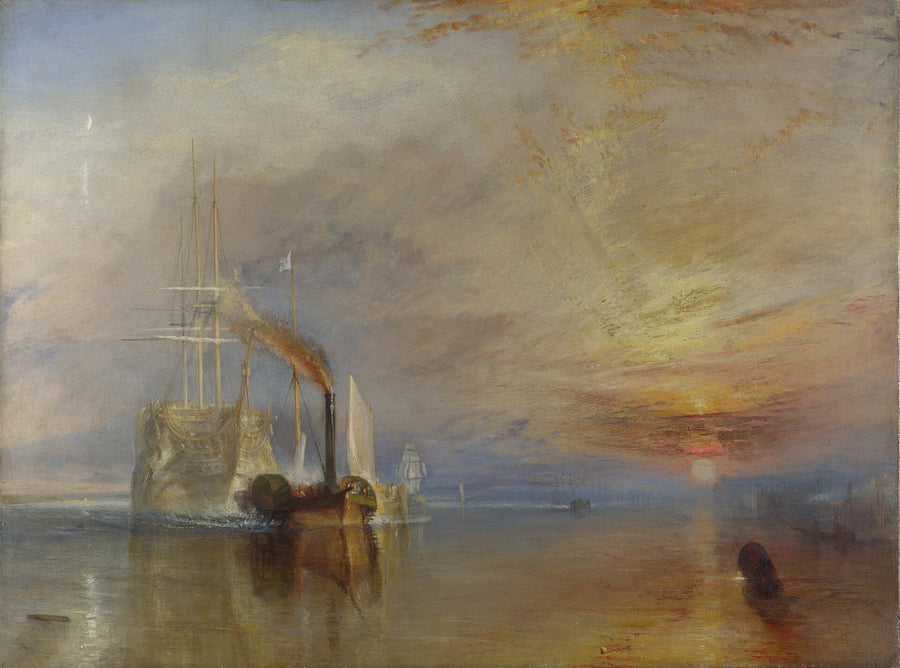
Molecules on their own give the clean reds and oranges. Larger particles in the air, such as volcanic ash and sulphate droplets, change the picture, and that has given atmospheric scientists an unexpected archive. In 2007 a team led by Christos Zerefos looked for sunset paintings made between 1500 and 1900. They found 554 by 181 painters and analysed the 327 that could be reliably dated, measuring the ratio of red to green along the horizon. Paintings made within three years of a major eruption had red to green ratios about 1.3 to 1.4 times higher than usual, and the ratios tracked an independent index of volcanic dust in the atmosphere. J. M. W. Turner and Edgar Degas were among the painters whose skies reddened after eruptions.7

After Tambora erupted in Indonesia in 1815, Europe saw red and orange sunsets for up to three years, and Turner painted them. A follow-up study published in 2014 tested the method by asking a painter to record sunsets on the Greek island of Hydra during a Saharan dust event in June 2010. The estimates taken from the paintings matched modern instrument readings.8
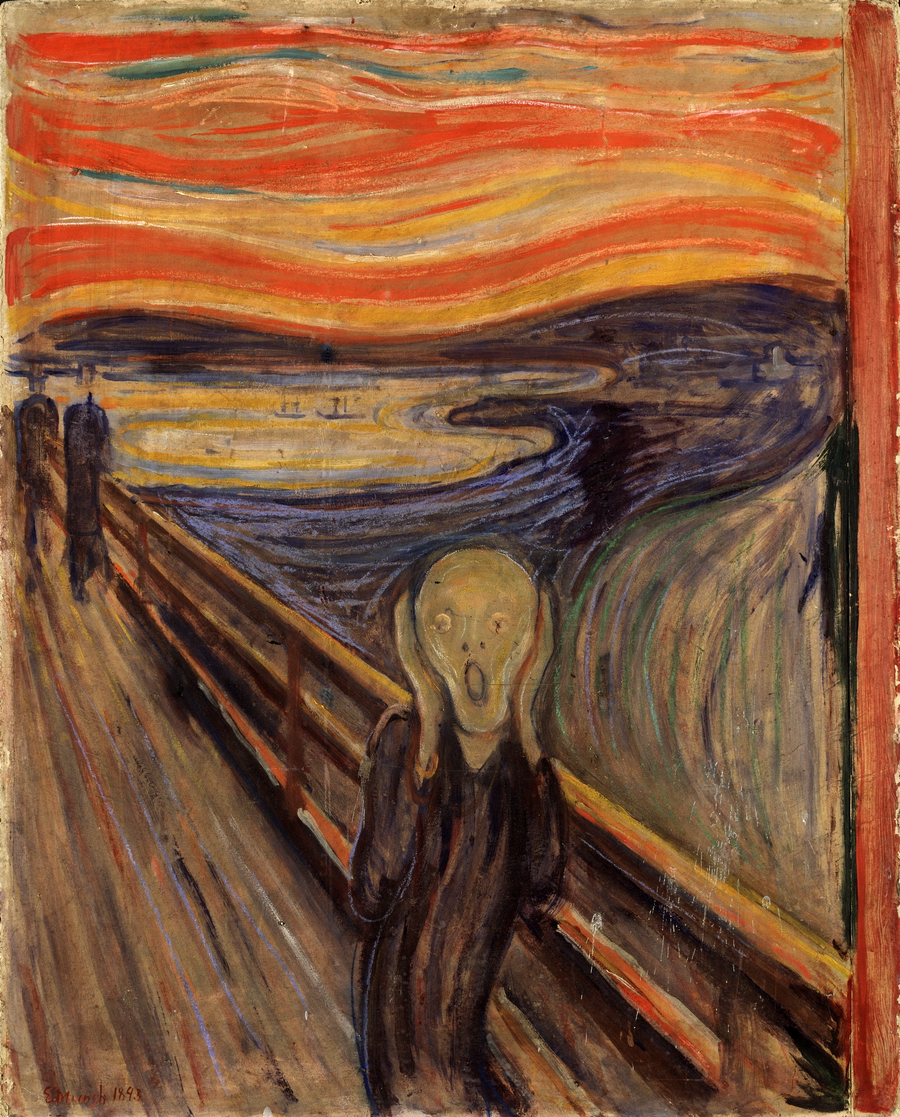
The Scream
The eruption of Krakatoa on 27 August 1883 produced vivid twilights around the world, and the Royal Society published a report of more than 300 pages on them. In 2004 Donald Olson and colleagues at Texas State University argued that the blood red sky in Edvard Munch's The Scream (1893) records one of these afterglows, seen from the Ekeberg hill above Christiania, now Oslo, in the winter of 1883 to 1884.9 The Zerefos team left The Scream out of their data because its date is disputed, though they suggested its strong reds might reflect Munch's memory of the Krakatoa sunsets.7

Not everyone accepts the volcano. In 2017 the meteorologist Helene Muri presented work at the European Geosciences Union meeting in Vienna, developed with her late colleague Jón Egill Kristjánsson, proposing that the wavy bands in the painting look more like nacreous or "mother of pearl" clouds. These form when moist air is pushed up over mountains into the stratosphere and glow just after sunset. Kristjánsson had argued that volcanic dust spreads as a thin, even layer that would not give the rippled sky Munch painted. Others read the sky as Munch's state of mind rather than the weather.10 The volcano, the clouds and the psychology each have their supporters, and the question has never been settled.
- Met Office, Why the sky is blue and sunsets red, Met Office.
- Royal Institution, John Tyndall's blue sky apparatus, Royal Institution of Great Britain.
- Wikipedia, Rayleigh scattering, Wikimedia Foundation.
- Ryan Leslie, Sky colours, Mathematics 309 course notes, University of British Columbia, 2004.
- Wikipedia, Air mass (astronomy), Wikimedia Foundation.
- F. Kasten and A. T. Young, Revised optical air mass tables and approximation formula, Applied Optics 28, 4735 to 4738, 1989.
- C. S. Zerefos, V. T. Gerogiannis, D. Balis, S. C. Zerefos and A. Kazantzidis, Atmospheric effects of volcanic eruptions as seen by famous artists and depicted in their paintings, Atmospheric Chemistry and Physics Discussions 7, 5145 to 5172, 2007.
- European Geosciences Union, Famous paintings help study the Earth's past atmosphere, EGU, 2014.
- Donald W. Olson, Russell L. Doescher and Marilynn S. Olson, The Back Page, APS News, American Physical Society, 2004.
- Eos, Science offers new clues about paintings by Munch and da Vinci, American Geophysical Union, 2017.